

The other day I found myself back in the womb. It was an exciting experience although not for the reasons you may assume. Our mother was wholly obliging and I was not the only one so entrenched.
A Tale of Two Beautiful Days
On the 18th of May, I took an impulsive trip to Hartford, Connecticut. In order to get there from my home in Pawtucket, Rhode Island I needed to take a circuitous route through Massachusetts since there is no road resembling a straight line between the two. Which is how I found myself on Route 146 northward bound toward the Massachusetts Turnpike, only to head back south further west to Hartford.
It was a wonderfully bright, sunny and warm day, even at 7:30 in the morning when I departed my mill home. This in itself has been a rare occurrence so far here in Southern New England this year. About 15 minutes over the border between the two states I came upon a sign: Exit 6 Purgatory Chasm. The sign had other words on it but I did not see them. I only saw the enigmatic name of Purgatory Chasm. Promptly, I pulled out my phone, thumbed up the voice recorder and made note of this enticing and mysterious location.
Five days later, on another beautiful, warm and sunny day I set out late morning for this chasm that was beckoning to me. Why would a chasm beckon to someone? When you are one of Earth’s lovers, a frequenter of deep forests and a climber of rock, the word chasm strikes a strangely pleasurable sensation up and down your spine causing goosebumps on your forearms and tingles in places I’d rather not mention.
In thirty minutes I was there, eleven miles over the border in an area of central Massachusetts known as Sutton. Under the auspices of the state’s Department of Conservation and Recreation, the area is known officially as Purgatory Chasm State Reservation. It totals about 100 acres, although the actual chasm is only about a quarter mile long.
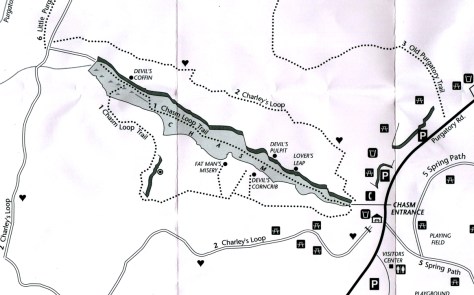
The Giant Gash
The Chasm is now thought to have its origin in the sudden release of dammed-up glacial meltwater near the end of the last Ice Age, approximately 14,000 years ago. Long ago its origins were thought to be of a much different nature – even before it was thought to be due to the force of an earthquake. More on that in bit.
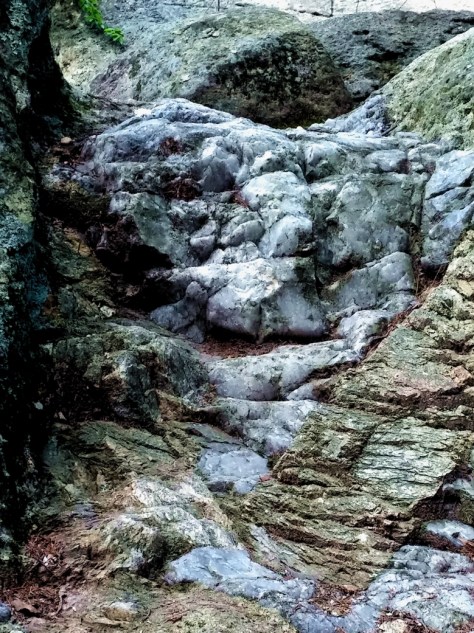
Carved out of granite, the walls at times reach 70 feet high. Within this giant gash-in-the-land, you find huge boulders in various states of having been shattered and strewn by the force of that water. I had a distinct feeling that should an earthquake hit the area, this chasm and the ledges above would not be a good place to be standing!
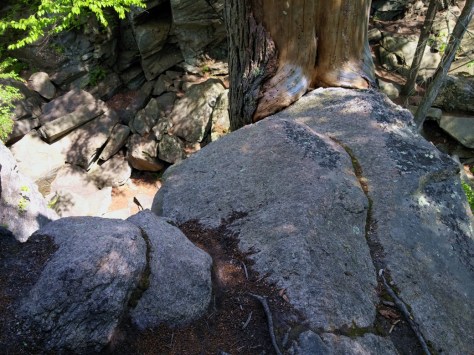
Disregarding that feeling, the majesty of the sheer size of the rock and the pieces of rock were humbling. No, this is no Grand Canyon, but rather, a more sacred and at-home-like sanctuary. Everything is so close to you. Listening, the voices of past visitors seemed present in the cool air (when the voices of the present visitors – of which there were a fair amount – were not heard). You get the feeling of almost being entombed.
Everywhere you look and touch there are stories of impressive energy. You can trace and map where rock has cleaved from other rock. You can look up and watch how one boulder dislodged from a portion of the wall or ledge above. And most intimidating, you can envision where the next piece of rock will fall from and where it will land.
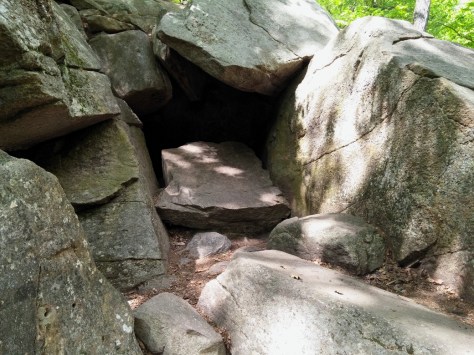
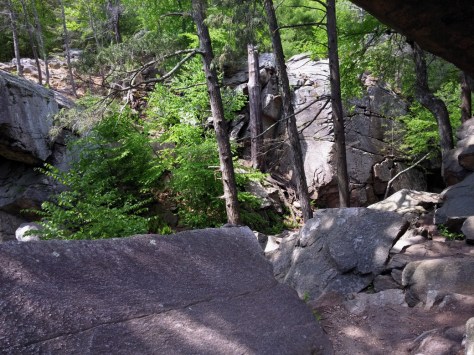
I was more intent on exploring, so these few pictures I’ve taken with my phone do not do justice to the true experience.
The Name
I spent about four hours there, walking the perimeter of the chasm ledge (which was wide at one end and narrow at the other) and through the depths of the slashed earth one way and then the other. Each pass taking numerous routes up and down the boulders and cracks and crevasses, from floor to ledge and from ledge to floor. In and out of the chasm.
Time passes without notice when you are both concentrating on where to next place your feet and hands as well as soaking in the vibration of the energy put out by Mother Earth in this most holy of spots. You stop and look, planning out the next route, determining whether or not you think you can do it. You notice your breath and you notice the quick burst of energy needed here at some points, and the steady, balanced placements of your body at others.
Yet, there was still time to ponder the most obvious, and seemingly basic of questions one has when visiting this magical spot: Why is it called Purgatory Chasm?
I more or less immediately deduced the answer and found myself confirmed at every point of reference. However, I wanted to see if I was right – if others thought as I did, or if perhaps I am just a deranged and perverted man. Could I be the only one to feel that this chasm, this giant chasm, was vaginal in its symbolism?
And if so, why is it called Purgatory Chasm?
The Meaning
First off, let’s get something out of the way. The meaning of the name of this natural chasm in the Earth is lost. Furthermore, there are two Purgatory Chasms in Southern New England. The second one is in Middletown, Rhode Island. It is significantly less impressive (although not lacking in beauty) as one 10 foot wide by 50 foot long glacial cleft along the ocean that allows seawater to flow through.
The folklore attached to this particular Rhode Island chasm (or as I’d rather put it – singular cleft) is one of a Native American Devil named Hobomoko. It seems a beautiful native woman was attacked by a white settler nearby. After crying out for help to no avail, she could not stop his unwanted advances so she fought back and killed him. Hobomoko, enraged and giddy over this act, drug her to this spot along the coast, creating devil’s footprints along the way, and swung his tomahawk down upon her taking both her head and her life in one mighty swoop. A swoop so mighty that it left this slit in the rock for all eternity.

Or something like that, there are several versions. I did find one reference to this Hobomoko legend attached to the chasm in Massachusetts, but I believe it to be in error. It seems the Rhode Island tomahawk story has more references and quite frankly makes more sense. There are many clefts in the Massachusetts chasm area and the main chasm itself does not look like a clean tomahawk swipe. Regardless, the story was probably made up to convince the natives that they needed to abandon their heretical beliefs and convert to Christianity anyway.
So if the reason this particular area is named Purgatory Chasm remains unknown, then its meaning is fair game to the speculative. Like me.
Not Phallic, but……
Purgatory is defined as a state after death where a soul goes to purify itself through the punishment it is due for its sins. The soul is not damned to eternal hell, it is merely temporarily suffering so it can achieve holiness as to enter heaven. Kind of like being spanked and told to sit in the corner for a while before dinner – or sent to bed without dinner (after being spanked of course). The term is from Roman Catholic doctrine but has been in use since the 12th century. So the early, shall we say, puritanical settlers were well aware of the concept of Purgatory.
A chasm is a deep fissure in the earth, rock or another surface. It could also be a deep rift, or a profound difference between people, viewpoints or feelings. I think we’ll be safe going with the former definition, however, I think a double entendre in the name may lead one to include the latter definition as well.
If you spend any time out in nature, on this living being we call home, surrounded by life, you will find yourself anthropomorphizing. That is you will find yourself giving human characteristics to non-human beings or things. It’s a perfectly natural thing to do.
You will see human figures, faces and body parts in trees and rocks. You will see them in leaves, and the shadows the leaves cast. You will see them in the way a tree or tree limb has fallen or the way rocks have tumbled together. They are everywhere. They are the genesis of all our stories of ghosts and goblins in the woods.
And, if you really do spend a lot of time out in the woods, you will most definitely begin to notice how many things seem to look like human genitalia. In fact, you may see it so often, you dismiss it. But how do you suppose the term phallic even came about (phallus being Greek for penis)? There are many things in nature that look like penises. Everyone has seen two massive trees growing out of the ground together like giant legs with another smaller, thinner tree growing out between them!
There are also many things in nature that are vaginal – or look like vaginas. Ever see a particular shape to a hole in a tree? Ever see a particular shape to a crack in a big rock? Ever see a giant chasm in the ground which if viewed in the winter or from slightly above would clearly show a slotted opening with apparent lips around it that doesn’t resemble a mouth?
Get off exit 6 from Route 146 in Sutton, MA and I’ll show you one.
A New Legend
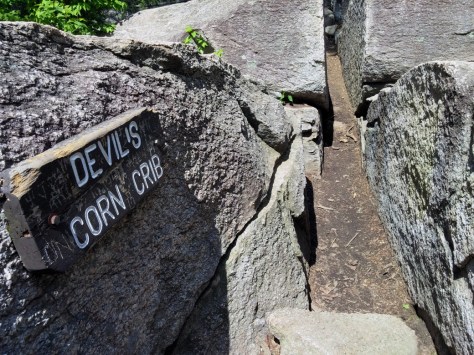
So as I navigated myself through this chasm in purgatory, and I found rock outcroppings with signs that declared their names to be Devil’s Corn Crib, Devil’s Pulpit, Devil’s Coffin, Lover’s Leap and a singular cleft named Fat Man’s Misery all within a geological formation known as Purgatory Chasm, I came upon my own story for how this particularly vaginal rock formation found its name.
I believe the natives held this particular area to be very sacred. I’m sure each set of tribes had their own particular name for it, which if I started asking around local tribes I might uncover the most recent. Whatever the native-language name may have been when the settlers first arrived here, I feel the name would have meant something like this: Entrance to the Womb of the Mother. Ancient traditions throughout the world represented the Earth as a womb, and as female or the mother. This name would not be out of line.
So what happened when these early settlers discovered the native-given name of this place, experienced the similarities and symbolism themselves, and had to reconcile that with their dogmatic religion they fled the old world to practice without persecution?
No doubt they word purgatory did not come to mind first! Given the long-standing formation references to the devil, I’m sure it may have first been referred to as Devil’s Chasm, or The Chasm of Hell, or Hell’s Gate.
Back then (okay – even now still), other than to procreate, sex was viewed as sinful and not to be discussed. I’ll bet women and children may have even been forbidden to go to this sinful place. Only the men had that privilege (under the guise that it was for their safety – the rocks being too dangerous for women and children).
Besides, women were not thought very highly of to begin with – in this patriarchal society (think Salem and witches). Anything that resembled a woman’s – well you know what – would be inherently evil and dirty and shameful. The work of the devil for certain.
But somehow the name became Purgatory Chasm. Why? Perhaps after visiting often enough, over time, men began to realize that something so beautiful and awe-inspiring, could not have been the work of the devil. Only God himself could create something so majestic! So maybe The Chasm of Hell was a bit too harsh.
If God did create it, why did he choose to make it resemble a woman’s – well you know what – so closely? Well……sex and a woman’s – you know what – are dirty and sinful, all humans are inherently sinful, but yet a man must have a family. The deed must be done (and it was a rather pleasurable task at that). Perhaps this spot represented both pleasure and suffering. If a man must sin and have intercourse, then as a sinner he cannot go to heaven. But it cannot be an eternal damnable sin, a man had to reproduce.
Ahh, it could be a place of purgatory. A place where the suffering and the pleasure that caused the suffering could be reconciled. Perhaps even made holy. Okay, maybe they didn’t go that far!
Go Rejoice
So anyway, that’s my story and I’m sticking with it. Whether you believe it or not doesn’t matter. You will never visit the place and not think of my version of the legend, I can guarantee that.
If you do visit, just inside the beginning of the chasm, after you have already handled a few of the smaller boulders, you will find this plaque on your left.

However, before you reach that plaque, chiseled into a one of the smaller boulders is this engraving.
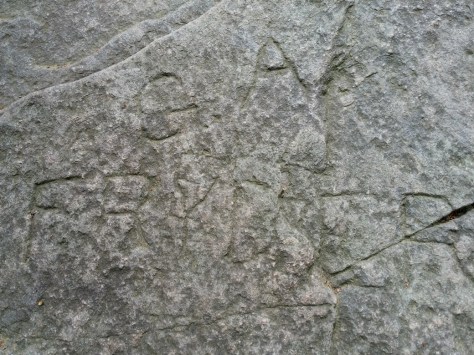
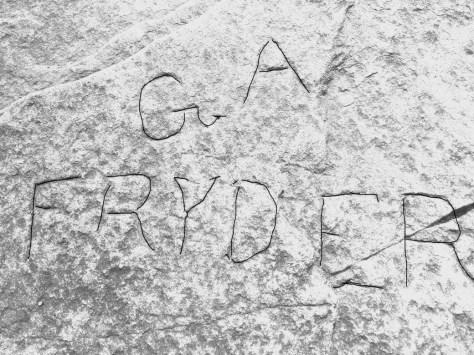
As you can see it says, in an older-style lettering that was obviously not chiseled by an accomplished craftsman, GA FRYDER. At first, I thought the GA referred to Georgia and I snapped the picture with the idea of sharing it with my friends in Savannah – from where I recently moved. But upon closer look, it didn’t seem to make any sense. So I forgot about it until I got home and began to do some research.
What I discovered was that these two words in Norwegian mean GO REJOICE. The pronunciation sounds like GAH-FREE-DIT. Now there weren’t a whole lot of Norwegian colonial settlers in Southern New England; but this typeface, and its obvious aging do seem to indicate that it is old. If this engraving is from that era, then either this person really enjoyed the beauty and majesty of nature, or – even in the 17th and 18th centuries, Norwegians had a much different point-of-view on women and sex. One that may have created a chasm between them and their European neighbors!
Take care and seek peace my friends,
Vince
__________________________________________
Unless otherwise indicated, all images are copyright vincegreen111058.







 Don't Mind Me ..... Just Listening To The Voices